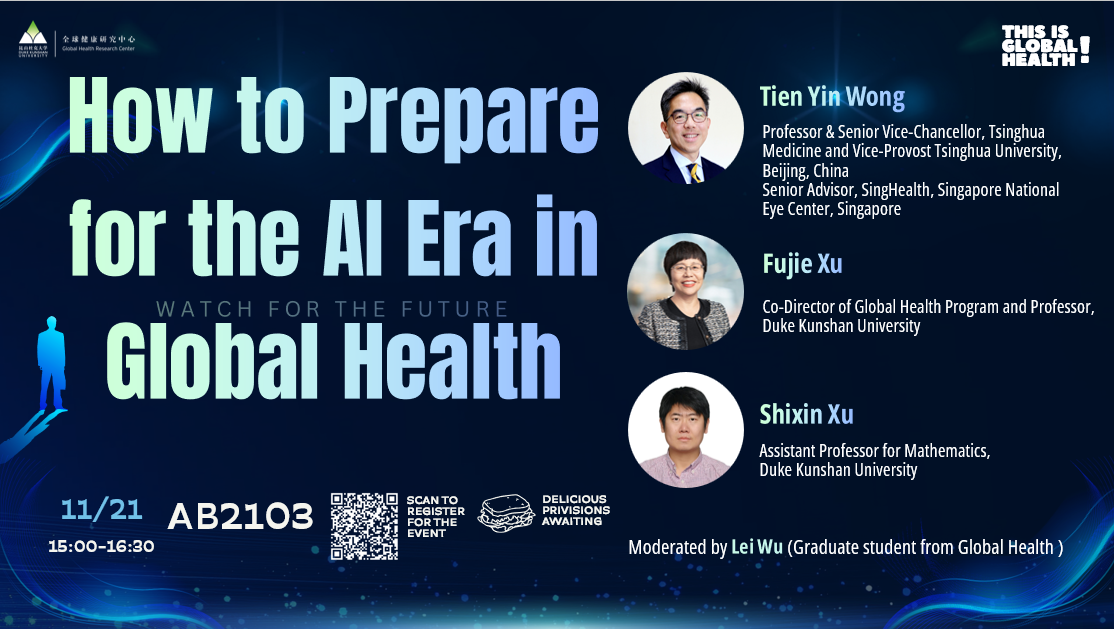
Event Details
Time: 15:00-16:30, November 21, 2025
Venue: Academic Building 2103 (AB2103), Duke Kunshan University
Language: English
Symposium Agenda
15:00–15:05 Welcome and opening remarks
Fujie Xu
Co-Director of Global Health Program and Professor, Duke Kunshan University
15:05–15:10 Introduction of the Speaker
Lei Wu
Student of MSc-GH Program, Class of 2026
Tien Yin Wong
Tien Yin Wong, Professor & Senior Vice-Chancellor, Tsinghua Medicine and Vice-Provost Tsinghua University, Beijing, China
15:50–16:25 Panel Discussion and Q&A with audience
Panelists:
Tien Yin Wong,
Professor & Senior Vice-Chancellor, Tsinghua Medicine and Vice-Provost Tsinghua University, Beijing, China
Fujie Xu,
Co-Director of Global Health Program and Professor, Duke Kunshan University
Shixin Xu,
Assistant Professor for Mathematics, Duke Kunshan University
16:25–16:30 Event wrap-up
Tien Yin Wong
Professor & Senior Vice-Chancellor, Tsinghua Medicine and Vice-Provost Tsinghua University, Beijing, China
Professor Tien Yin Wong is a physician-scientist-innovator and the Senior Vice-Chancellor of Tsinghua Medicine and Vice-Provost of Tsinghua University, China. He has worked and held senior leadership roles in Singapore and Australia, including at the National University of Singapore. SingHealth Duke-NUS Academic Medical Centre, Singapore National Eye Centre and University of Melbourne. Prof Wong is a practicing retinal specialist, with a research portfolio on retinal diseases, ocular imaging, AI and digital technology. He has published >1,600 peer-reviewed papers (H-index 229, highly cited researcher 2020 to 2025), given >500 invited named, plenary and symposium lectures, and received >US$100 million in grant funding. Prof Wong has been recognized with multiple international awards, including Arnall Patz Medal (Macula Society), the Jose Rizal Medal (Asia Pacific Academy of Ophthalmology) and the Friedenwald Award (ARVO). He has received Singapore’s President’s Science and Technology Award. He is an elected international (foreign) member of the US National Academy of Medicine and the Australian Academy of Health and Medical Sciences. He is also an elected fellow of the UK Royal Society.
Fujie Xu
Dr. Fujie Xu’s research interests focus on outbreak detection and health emergency response, and she was a “disease detective” in the global response to epidemics and pandemics, including the SARS outbreak and the H1N1 influenza pandemic. During “peace” time, her research focuses on the introduction of new vaccines, diagnostics and treatments against infectious diseases in the United States, China and other Asian countries. She has published widely on various aspects of infectious diseases, particularly HIV/STD, viral hepatitis infections, and emerging and re-emerging infections. She has extensive experience in health product innovations. Prior to her appointment at DKU in January 2025, she was the Deputy Director for Health Innovation and Partnership at the Gates Foundation’s China Country Office. Her teaching interests at Duke Kunshan include an introduction to global health institutions, global health challenges, and large-scale global health practice and programs. Xu received an MD in preventive medicine from Peking University and a PhD in epidemiology from Emory University. She did her postdoctoral training as an EIS officer at US CDC in Atlanta.
Shixin Xu