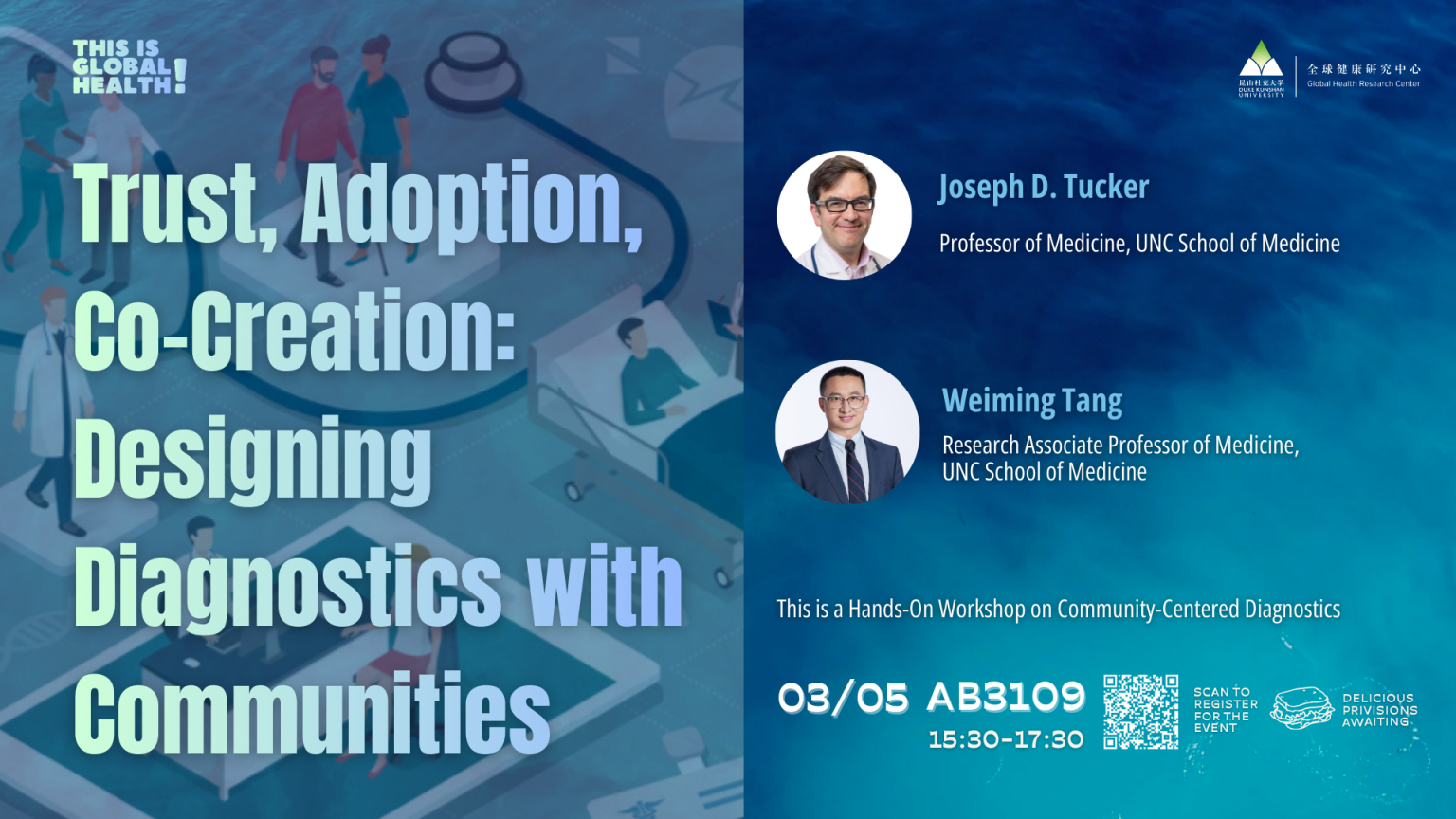
Event Details:
Time: 15:30-17:30, March 5, 2026
Venue: Academic Building 3109 (AB 3109), Duke Kunshan University
Language: Mandarin
Symposium Agenda
15:30-15:35 Welcome and opening remarks
Prof. Fujie Xu,
Co-Director of Global Health Program and Professor, Duke Kunshan University
15:35-15:45 Introduction to Diagnostics
Prof. Weiming Tang,
Research Associate Professor of Medicine, UNC School of Medicine
Joseph D. Tucker,
Professor of Medicine, UNC School of Medicine
15:55-16:40 Small-group co-creation exercise using real-world diagnostic scenarios
Prof. Joseph D. Tucker,
Professor of Medicine, UNC School of Medicine
Prof. Weiming Tang,
Research Associate Professor of Medicine, UNC School of Medicine
16:40-17:00 Group feedback and facilitated synthesis
Group Representatives
17:00-17:05 Closing Reflection
Prof. Joseph D. Tucker,
Professor of Medicine, UNC School of Medicine
17:05-17:30 Networking with Students
Prof. Joseph D. Tucker,
Professor of Medicine, UNC School of Medicine
Prof. Weiming Tang,
Research Associate Professor of Medicine, UNC School of Medicine
Professor of Medicine, UNC School of Medicine
Joseph D. Tucker is an infectious diseases physician and Professor at the University of North Carolina at Chapel Hill. His research focuses on practical, community-engaged approaches to public health. He has worked in China for over two decades on participatory research, diagnostics, and innovative service models. Dr. Tucker’s work bridges research, policy, and on-the-ground implementation, with a strong emphasis on learning from communities and designing services that benefit communities. He was the Co-Chair of the WHO Guideline Development Group on Multiplex Testing. He frequently works with students and early-career researchers on co-creation methods that can be applied to coursework, field studies, and future careers in global health, medicine, and social innovation.
Weiming Tang
Research Associate Professor of Medicine, UNC School of Medicine
Dr. Weiming Tang is an epidemiologist and Associate Professor at the University of North Carolina at Chapel Hill with extensive experience working in China on diagnostics, sexual health, and community-based research. His work focuses on developing practical solutions to improve access to HIV, STI, and hepatitis testing by addressing barriers such as stigma, trust, and service design. Dr. Tang has led multiple RCTs across Chinese cities and provinces, collaborating closely with local health providers, community organizations, and students. He is the PI on an NIH NIAID R01 grant and has published over 400 publications, including first-author publications in Nature Medicine, Clinical Infectious Diseases, and other top journals.
About “This is Global Health! Monthly Symposium Series”
Since 2014, the Global Health Research Center (GHRC) has organized a series of global health symposium events, inviting leaders, scientists, and industry experts in the global health field to exchange information on the latest research progress, international and domestic development trends, and global health education and practice. By February 2026, GHRC had successfully hosted 205 seminars.