


A new collaborative study published in PLOS Global Public Health has revealed stark socioeconomic and geographic inequities in the availability of essential vaccines across China. Led by first author Mr. Lei Guo, Senior Research Fellow at the Innovation Lab for Vaccine Delivery Research at Duke Kunshan University, the project represents a major joint effort alongside the China National Health Development Research Center (NHDRC), Fudan University, the World Bank Group, Duke University, and Duke-NUS Medical School.
What the Researchers Did
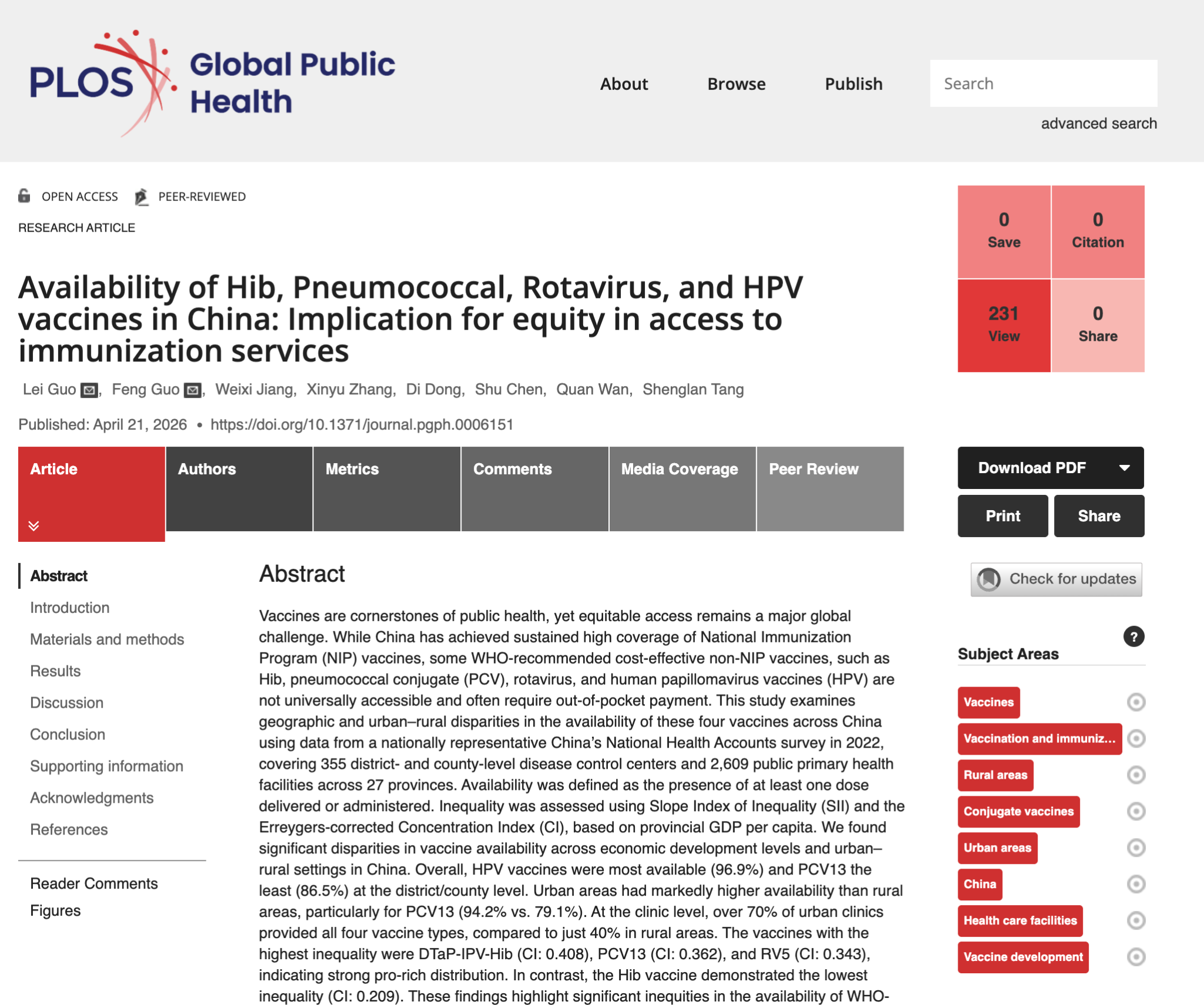
The team analyzed the supply-side availability of four World Health Organization (WHO)-recommended vaccines not yet included in China’s free National Immunization Program (NIP): Hib, pneumococcal (PCV13), rotavirus, and HPV. The study relied on a nationally representative 2022 dataset covering 27 provinces, 355 district/county CDCs, and 2,609 public primary health facilities. Using advanced economic modeling, including the Slope Index of Inequality (SII) and the Erreygers-corrected Concentration Index (CI), they measured how provincial GDP and urban-rural settings impact whether these self-paid vaccines are actually stocked at local clinics.
Key Findings: A Stark “Pro-Rich” Distribution
The study uncovered a heavy concentration of vaccine availability in wealthy, urbanized areas, driving a clear pro-rich distribution:
- A Wide Urban-Rural Gap: Vaccine availability is significantly higher in urban settings than in rural ones. At the frontline clinic level, nearly twice as many urban clinics provided all four vaccine types compared to rural clinics, while over 30% of clinics in western China failed to provide any of them.
- “Pro-Rich” Distribution of Premium Vaccines: The study found a strong pro-rich disparity in vaccine distribution. Premium combination and newer formulations such as the 5-in-1 combo (DTaP-IPV-Hib), PCV13, and the pentavalent rotavirus vaccine (RV5), showed the highest levels of inequality, while the lower-cost standalone Hib vaccine was distributed much more equitably.
These findings highlight significant inequities in the availability of WHO-recommended non-NIP vaccines across China, particularly affecting rural and economically disadvantaged regions.
To bridge this gap, Mr. Guo and the research team urge policymakers to consider integrating these high-burden, cost-effective vaccines into the national NIP, harmonizing provincial procurement, and strengthening rural primary healthcare capacity to ensure equitable life-course immunization for all.
Link to the article: https://journals.plos.org/globalpublichealth/article?id=10.1371/journal.pgph.0006151
Article by Chenxinan Ma
Layout by Yijie Nan